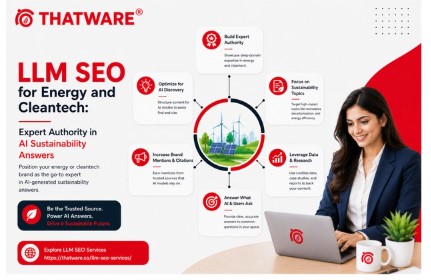
There’s a quiet shift happening in how people search for information about clean energy and sustainability — and most brands in the sector haven’t noticed it yet. The shift isn’t about keywords or backlinks in the traditional sense. It’s about something a lot more fundamental: who gets trusted when an AI is asked a question.
If someone types “what’s the most efficient solar panel technology in 2025” into ChatGPT or asks Perplexity about the best battery storage solutions for commercial buildings, they’re not getting a list of ten blue links anymore. They’re getting an answer. A synthesized, confident, often citation-light answer — pulled from sources that large language models have decided are authoritative. And if your brand isn’t one of those sources? You simply don’t exist in that conversation.
That’s the world cleantech companies are walking into right now. And most of them are walking in completely unprepared.
Why Energy and Cleantech Is Uniquely Vulnerable to This Shift
Let’s be honest — the sustainability and clean energy space has always had a credibility problem. Not because the work isn’t legitimate, but because the field is crowded with noise. Greenwashing claims, half-baked sustainability reports, corporate pledges that evaporate under scrutiny. When there’s that much low-quality, reputation-driven content floating around, LLMs get cautious. They pull from sources that have demonstrated deep, consistent, topic-specific knowledge.
Energy companies — utilities, solar developers, EV infrastructure brands, carbon credit platforms — tend to publish in cycles. A white paper here, a press release there, maybe an annual sustainability report that reads more like a marketing brochure than an actual knowledge resource. That’s not the kind of content that earns trust from an AI system trying to determine who really knows their stuff on grid-scale battery storage or offshore wind permitting.
And that’s exactly the gap that professional LLM SEO services for brands in this space are starting to fill. It’s not just about writing more content — it’s about writing the right content in ways that LLMs can parse, extract, and ultimately cite.
What LLMs Actually Look for When Answering Sustainability Questions
Here’s where it gets a little technical, but stay with me because this part matters.
When a language model processes a query about, say, “what are the environmental trade-offs of lithium mining for EV batteries,” it’s not doing a keyword search. It’s doing something closer to expertise mapping. It’s asking: which sources have addressed this topic comprehensively, consistently, and in a way that reflects genuine domain knowledge?
That means entity clarity matters. If your brand publishes about solar energy but your content never clearly connects your brand name to specific subtopics — residential solar installation, utility-scale PV projects, net metering policy — you’re invisible in those entity maps. LLMs don’t guess. They work with what’s explicit.
It also means semantic depth matters. A 500-word blog post that mentions “renewable energy” seventeen times but never actually explains how power purchase agreements work is not going to help you. What helps is content that answers real questions at a level of depth that signals you’ve actually worked in this space. Think less “what is net zero” and more “how do scope 3 emissions calculations differ between manufacturing-heavy and service-based companies.”
Topical authority clusters — interlinking content around tightly defined subtopics — are genuinely more effective in the LLM era than they were even two years ago. That’s not a coincidence.
The Authority Problem in a Noisy Market
One thing that separates cleantech from, say, personal finance or healthcare when it comes to LLM trust signals is the pace of regulation and policy change. Energy markets are deeply regional and regulatory frameworks shift constantly — IRA tax credits, state-level RPS standards, interconnection queue reforms. A brand that can demonstrate it’s staying current with these shifts, and publishing genuinely useful analysis of what they mean, earns a different kind of trust.
This is where the concept of “AI entity authority” becomes concrete rather than abstract. An AI entity isn’t just your brand name — it’s the cluster of concepts, people, credentials, and topics that are consistently associated with your brand across the web. A cleantech company that publishes op-eds, speaks at industry conferences, gets quoted in trade journals, and maintains a robust knowledge base on their own site is building that entity. One that just runs Google Ads and updates their homepage copy once a year is not.
Partnering with an AI LLM optimization agency that actually understands both the LLM landscape and the energy sector is less of a luxury at this point and more of a competitive necessity — especially as larger players start waking up to this dynamic.
Practical Things That Actually Move the Needle
Let’s get concrete for a moment. What does LLM SEO actually look like for an energy or cleantech brand?
It starts with a content audit — not a standard SEO audit, but a genuine look at whether your existing content would help an LLM answer a real question. Would a model reading your website understand that you’re an expert in distributed energy resources? Or would it just see a company that’s generally enthusiastic about clean energy?
Then comes structured knowledge development. This means creating what some practitioners call “answer-first” content — pieces that open with a clear, citable claim and then support it with evidence, data, and nuance. Pieces that are internally linked to other pieces that reinforce the same topical domain. Pieces that mention your brand in conjunction with specific technical concepts, not just generic sustainability language.
Schema markup matters more than most energy marketers realize. Proper FAQ schema, HowTo schema where applicable, and especially Organization schema that clearly defines what your company does, who it serves, and what geographic and technical domains you operate in — these are all signals that LLMs can pick up when crawling and indexing content.
Don’t underestimate the power of third-party validation either. Getting your team’s thought leadership published on credible external platforms — industry publications, university research blogs, policy think tanks — creates the kind of cross-source corroboration that LLMs weigh heavily when deciding what’s authoritative.
The Window Is Still Open, But Not for Long
Here’s the thing about being early to this: the cleantech and energy space still has breathing room. Unlike some sectors where major brands have already locked in their LLM authority, most energy companies are still operating on a search strategy that was designed for 2018. That means the brands that move now — that start treating LLM visibility as seriously as they treat paid media or traditional SEO — have a genuine window to establish authority before the space fills up.
That won’t last. As AI-powered search becomes the default for a growing share of users, the brands that have built deep, credible, well-structured knowledge resources will consistently appear in the answers. The ones that haven’t will start noticing their organic visibility declining in ways that traditional SEO tools can’t fully explain.
The transition to clean energy is, at its core, a story about being ahead of the curve. It’d be more than a little ironic if the companies leading that transition got left behind in the information economy because they were slow to adapt their visibility strategy.
The tools exist. The frameworks are evolving quickly. And there are teams — real ones, with actual expertise in both AI systems and sector-specific content strategy — who are doing this work now. The question is just whether your brand is going to be part of that first wave or spend the next two years trying to catch up.